Why Do WhatsApp Orders Get Lost at Peak Hours?
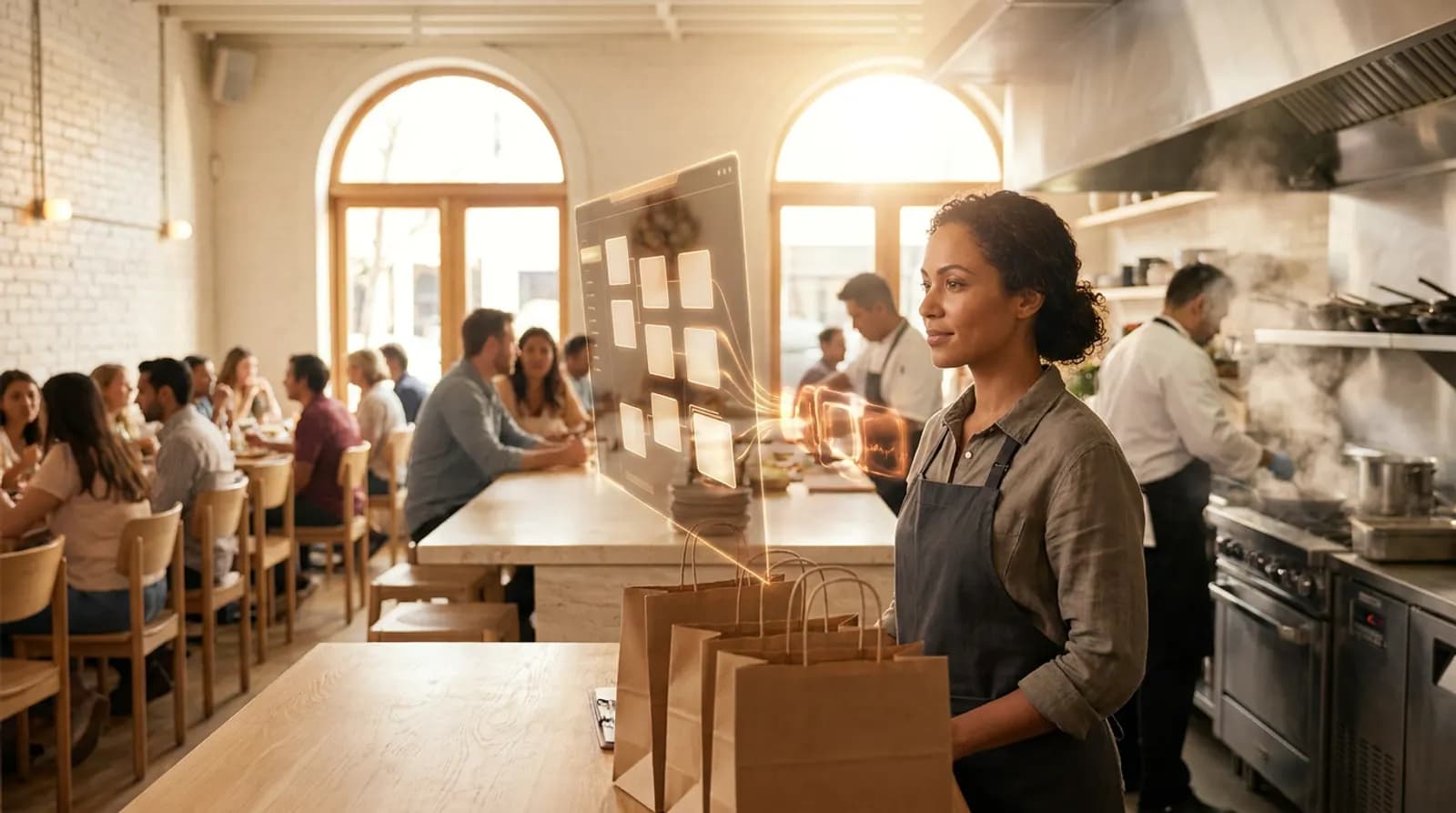
At lunchtime more WhatsApp orders come in and no one has time to answer them: the cashier is serving the line and the kitchen never stops. The customer who wrote to order doesn't wait; they order somewhere else. Here is how to cover that hour without hiring anyone.
Quick answer
At peak hours WhatsApp orders get lost because no one has time to answer them: the customer waits a few minutes and orders elsewhere. An AI agent set up with the restaurant's real menu takes the order, confirms it with the total and delivery time, collects payment if configured, and sends it to the kitchen; complaints and special cases always go to a person.
Why do WhatsApp orders get lost at peak hours?
Because the moment most messages arrive is the moment no one can answer them. At lunchtime, whoever runs the register has a line in front of them, servers are at the tables and the kitchen doesn't stop. WhatsApp waits for a free moment, and that moment comes too late. The customer who wrote to order knows none of this: they only see that no one replies.
Why does this matter now?
Because customers already expect to buy without leaving the conversation. Chattigo, a WhatsApp Business solutions provider, describes conversational commerce —discovering, asking and buying inside the chat— as the model taking hold among Latin American SMBs for 2026. For a restaurant, that means WhatsApp orders are no longer a side channel: they are part of the day's sales.
Source: conversational AI trends in Latin America for 2026 (Chattigo)
What happens to an order no one confirms?
It almost always becomes another restaurant's sale. These are the moments it slips away:
Read also: who answers a clinic's WhatsApp after hours
- The customer asks if a dish is available and no one answers in time.
- They order, but no one confirms the total or the delivery time, so they don't know if the order exists.
- The order is written down by hand and reaches the kitchen incomplete.
- It's confirmed, but no one says when it's ready, so the customer arrives early or gives up.
What can an AI agent do with orders, and what can't it?
A well-configured agent handles the repetitive part of an order; anything sensitive goes to a person.
The agent handles
What's on the menu, prices and hours
A person handles
Complaints about an order or the service
The agent handles
Taking the order and reading it back to confirm
A person handles
Special orders or catering
The agent handles
Giving the total and the estimated delivery time
A person handles
Allergies or ingredient questions the menu doesn't answer
The agent handles
Collecting payment through a link, if configured
A person handles
Changes once the order is being prepared
The agent handles
Telling the customer when the order is ready
A person handles
Any case where the customer asks to talk to someone
| The agent handles | A person handles |
|---|---|
| What's on the menu, prices and hours | Complaints about an order or the service |
| Taking the order and reading it back to confirm | Special orders or catering |
| Giving the total and the estimated delivery time | Allergies or ingredient questions the menu doesn't answer |
| Collecting payment through a link, if configured | Changes once the order is being prepared |
| Telling the customer when the order is ready | Any case where the customer asks to talk to someone |
How do you set it up for your restaurant?
The agent works with the business's real information and introduces itself as the restaurant's virtual assistant. To work well:
- It's loaded with the real menu, prices and hours, and updated when they change.
- It connects to the way the kitchen receives orders today, so orders arrive complete.
- It has clear rules to hand the conversation to a person: complaints, allergies, events or whenever the customer asks.
- It leaves the person in charge a record of every order and conversation.
- It handles customer data in line with Mexican personal data protection law.
Where should you start?
First, measure how long your restaurant takes today to answer a WhatsApp order at lunchtime. If the answer takes longer than your customer is willing to wait, that's your first opportunity. ATENEA FoodSuite brings together a QR menu, pickup through your own channel, customer follow-up and a 24/7 agent that answers WhatsApp and calls.
Frequently asked questions
Does the customer know they're talking to an AI?
Yes. It's good practice for the agent to introduce itself as the restaurant's virtual assistant and offer to connect with a person at any time.
What if the customer has a complaint?
The agent recognizes it and hands the conversation to the person in charge, with the full history so the customer doesn't have to repeat what happened.
Does it work if my menu changes often?
Yes, as long as the menu is updated in the source the agent uses. When a dish runs out, the agent stops offering it as soon as it's marked unavailable.
Do I need to change my point-of-sale system?
Not necessarily. If your POS has an open integration, orders can arrive directly; if not, your team enters them from the summary the agent leaves.
Does it replace my staff?
No. It takes over answering and confirming during the hours no one can; your team keeps serving guests in the restaurant and handling special cases.
Conclusion
At peak hours, the order goes to whoever answers. A well-configured agent takes and confirms WhatsApp orders while your team runs the restaurant, and leaves to a person what truly needs a person.
Request a free diagnosis of your WhatsApp orders