From Word of Mouth to Automated Sales: How an Industrial Supplier Stops Losing Customers with Artificial Intelligence
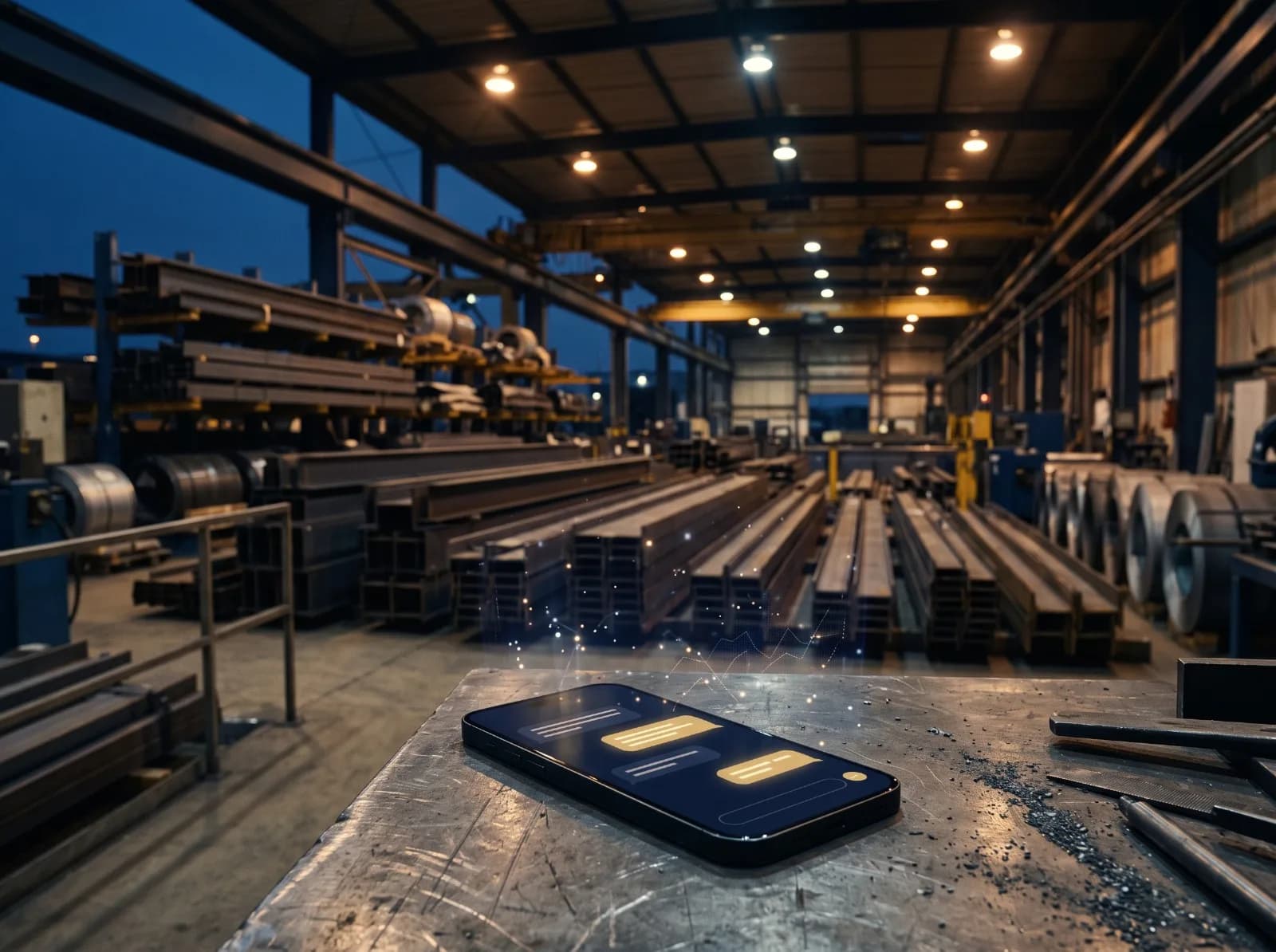
An industrial supplier's growth ceiling is word of mouth: it isn't predictable, can't be budgeted, and doesn't scale at the pace today's B2B buyer moves. For years, growth at many industrial companies has depended almost entirely on referrals.
Quick answer
An industrial supplier automates its commercial operation with three layers: local visibility on Google, a CRM that centralizes every lead, and an artificial intelligence agent that answers on WhatsApp 24 hours a day. Paco Steel, a structural steel supplier in Tucson, Arizona, implemented this model with ATENEA IA: today every WhatsApp quote request gets an immediate reply, at any hour, and every lead is logged in the CRM.
Why does word of mouth stop working in an industrial business?
Because the buyer changed before the supplier did. A buyer at a construction firm, a workshop, or a plant no longer calls three acquaintances: they search on Google, open the business profile, read reviews, and request a quote over WhatsApp — often outside office hours. At that moment they are not comparing product quality: they are comparing response speed. The consequence is harsh and silent: the company with the best steel, the best price, and the best reputation loses the order to whoever answered first. The deal is not lost on product. It is lost on operations.
The three bottlenecks holding back a B2B supplier
Across the diagnostics we run for industrial companies, three problems repeat almost without exception:
- Leads scattered across ownerless channels: messages arrive via WhatsApp, social media, phone calls, and forms. Nobody is formally responsible for any of those channels, there is no committed response time, and part of the volume simply goes unanswered. Nobody knows how much, because nobody measures it.
- Without a CRM, the pipeline lives in the team's memory: follow-up depends on spreadsheets, notebooks, and a salesperson remembering. There is no way to answer precisely the most basic question a sales director has: what stage is each lead in, and who is handling it?
- Growth with no engine, active demand that is never seen: every day there are buyers searching for a “structural steel supplier” in their area. If the business has no optimized profile and no structured digital presence, that demand exists but is invisible: someone else captures it.
How do you automate an industrial supplier's commercial operation?
This is not about replacing the human team, but about giving it the infrastructure to spend its time negotiating and closing rather than chasing messages. The system is built in three layers that work together.
- Layer 1 — Visibility: the business's digital presence is structured and optimized, starting with its Google profile: correct categories, services, attributes, photography, and a sustained review strategy. The goal is not to “be on the internet”, it is to appear among the first options when someone searches for that product in that city.
- Layer 2 — Smart CRM: every lead, no matter where it comes in from, automatically enters a single system. It is classified, assigned to an owner, and triggers follow-up alerts. The sales team stops working from memory and management gets full traceability for the first time: which channel brings customers, which ones close, and where money is being lost.
- Layer 3 — 24/7 AI agent on WhatsApp: it responds immediately, at any hour, on the channel the customer already uses. It answers frequent questions, qualifies the lead — material type, volume, use, delivery time —, sends information, and escalates the conversation to a human salesperson when the case warrants it. The operating rule changes completely: after hours no longer means a lost lead.
Real case: Paco Steel, structural steel supplier in Tucson, Arizona
Paco Steel is a structural steel supplier operating in Tucson, Arizona, with customers in construction and manufacturing. It had a competitive product and a solid local reputation, but growth was limited by manual prospecting and total dependence on referrals. It is also one of our longest-standing clients and operates on the other side of the border, which required a bilingual system able to handle inquiries in English and Spanish without human intervention. The three layers described above were implemented. This is how the operation changed:
Metric
Prospecting
Before
Manual and referral-based
After
Active, with CRM and AI agent
Metric
Quote response
Before
Slow, office hours only
After
Immediate on WhatsApp
Metric
After-hours attention
Before
Lost lead
After
24/7 coverage
Metric
Lead traceability
Before
Spreadsheets and memory
After
Every lead logged in the CRM
Metric
Local search visibility
Before
No optimized profile
After
Optimized Google profile and review strategy
| Metric | Before | After |
|---|---|---|
| Prospecting | Manual and referral-based | Active, with CRM and AI agent |
| Quote response | Slow, office hours only | Immediate on WhatsApp |
| After-hours attention | Lost lead | 24/7 coverage |
| Lead traceability | Spreadsheets and memory | Every lead logged in the CRM |
| Local search visibility | No optimized profile | Optimized Google profile and review strategy |
“ATENEA IA completely transformed our commercial operation. We now have full control of our customers.”
— Daniel — Paco Steel, Tucson, Arizona
Read the full implementation breakdown in the Paco Steel success case
How long does it take and what does automating the commercial operation involve?
Implementing the three layers takes between four and eight weeks, depending on how much commercial information has to be structured. The first signals — improved response time and orderly lead capture — show up within the first weeks; the business effect depends on each industry's own buying cycle and is measured in the CRM. The investment model combines a one-time implementation fee with a monthly operation and continuous-improvement retainer. The exact figure depends on how many layers are activated and the volume of conversations; it is defined in the initial diagnostic, which is free.
Frequently asked questions
Is artificial intelligence useful for industrial B2B companies or only for retail businesses?
It is especially useful in industrial B2B. The higher the ticket and the longer the buying cycle, the more expensive it is to lose a lead for lack of a response. Automation does not close the complex sale: it ensures the lead arrives alive, qualified, and on time to the salesperson who does close it.
How long does implementation take?
Between four and eight weeks for the complete system. A WhatsApp AI agent on its own can go live sooner.
Do I have to change my current system or my ERP?
No. The approach is to connect, not replace. The system integrates with the tools the company already uses; replacing a functional ERP is never the first step.
Can an AI agent quote products with variable pricing, such as steel?
Yes, with defined rules. The agent provides ranges, availability, and delivery times, qualifies the requirement, and escalates to a human salesperson when pricing requires commercial judgment. The customer gets an immediate response; the company keeps control of the final price.
Does ATENEA IA work with companies outside Mexico?
Yes. We operate from Mexicali, Baja California, serve companies across Mexico, and work with clients in the United States. Our AI agents operate bilingually in Spanish and English, which is especially relevant for border markets.
Conclusion
Your company can also stop depending on word of mouth. The three layers — visibility, smart CRM, and a 24/7 AI agent — turn a reactive operation into a system that attracts, qualifies, and follows up even while the team sleeps. Book a free diagnostic and find out how much you are leaving on the table without an automated commercial system.
Book a Free Diagnostic